街头文化杂志封面设计排版提示词
来源: @MrLarus模型: ChatGPT
📸 示例图片
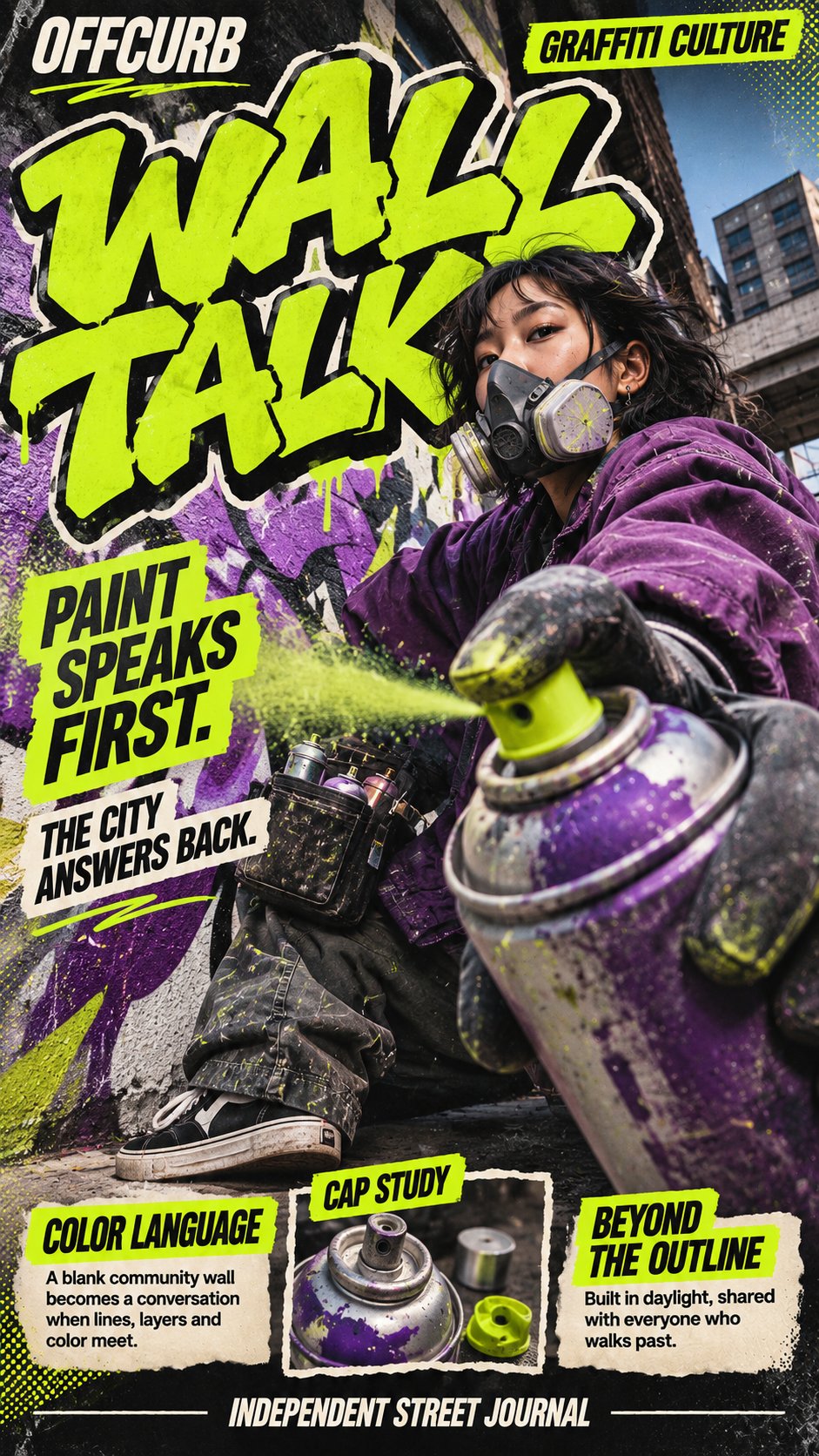
提示词
English
[CREATIVE THEME]: {Graffiti / Underground Music / Street Photography / Paste-up Art / Other Urban Creative Culture}
[PUBLICATION]: {Magazine or Brand Name}
[MAIN CHARACTER]: {Person, appearance and outfit}
[KEY OBJECT]: {Spray Can / Microphone / Camera / Poster / Other Object}
[PHYSICAL INTERACTION]: {What the person is doing with the object}
[LOCATION]: {Urban Environment}
[MAIN HEADLINE]: {English Title}
[SUPPORTING COPY]: {Two short English phrases}
[EDITORIAL SECTIONS]: {Two section titles and descriptions}
[COLOR PALETTE]: {2–3 main colors + 1 accent color}
[ASPECT RATIO]: 9:16

Create an original street culture editorial magazine cover combining authentic urban photography, physical object interaction and expressive graphic design.

 1. Core Visual Concept

The key visual principle is:

Real Objects × Human Interaction × Oversized Typography × Street Editorial Design.

Choose one dominant object that represents the creative theme.

Make the object visually prominent through dramatic perspective and natural interaction with the main character.

The object must physically participate in the scene rather than appear as a decorative element.

Examples of physical interaction:

- Graffiti: A spray can actively applying paint to a wall.
- Underground Music: A microphone being held toward the viewer during a live performance.
- Street Photography: A camera being raised to capture an urban moment.
- Paste-up Art: A large printed poster being applied to a wall, with naturally curling paper edges.

Select only the interaction relevant to the chosen theme.

 2. Photography & Spatial Relationships

Use ultra-wide photography and strong near-to-far perspective.

Create a clear relationship between the foreground object, the person's body and the urban environment.

Preserve believable anatomy, object structure, hand positioning, material properties and physical movement.

Use authentic urban environments rather than generic studio backgrounds.

 3. Typography & Editorial Design

Create an oversized, original graffiti-inspired headline with thick lettering, bold outlines and expressive hand-drawn character.

Typography should interact with the photograph through realistic overlapping, masking and layering.

Depending on the subject, typography may be integrated into a physical poster, wall artwork or independent editorial graphic layer.

Build a sophisticated magazine layout containing:

- Publication identity
- Editorial category
- Oversized main headline
- Supporting slogans
- Two editorial sections with meaningful copy
- A small photographic detail inset
- Magazine footer

Use condensed sans-serif headings and clean, readable body text.

 4. Print & Collage Aesthetics

Introduce controlled street-zine textures:

Halftone dots, Xerox photocopy grain, torn paper edges, screen-print imperfections, subtle ink misregistration and handmade graphic marks.

Use a limited palette of 2–3 dominant colors and one accent color.

Keep the photography sharp and realistic. Distressed textures should mainly affect the graphic design layers.

 5. Final Quality

Create a complete independent street culture magazine cover with strong visual hierarchy, high information density and authentic editorial craftsmanship.

Avoid random stickers, meaningless lettering, excessive decorations, unrealistic object interactions and generic advertising layouts.

Use the supplied English copy accurately.

Generate one complete, independent 9:16 vertical poster.
中文
[创意主题]:{涂鸦 / 地下音乐 / 街头摄影 / 拼贴艺术 / 其他城市创意文化}
[出版物]:{杂志或品牌名称}
[主角]:{人物、外貌及穿着}
[关键物品]:{喷漆罐 / 麦克风 / 相机 / 海报 / 其他物品}
[肢体互动]:{人物正在对物品做什么}
[地点]:{城市环境}
[主标题]:{英文标题}
[辅助文案]:{两段简短的英文短语}
[编辑板块]:{两个板块标题及描述}
[配色方案]:{2–3 种主色 + 1 种点缀色}
[纵横比]:9:16

创作一个原创的街头文化编辑杂志封面,结合真实的城市摄影、实物互动和极具表现力的图形设计。

 1. 核心视觉理念

核心视觉原则是:

真实物体 × 人物互动 × 超大排版 × 街头编辑设计。

选择一个代表创意主题的主导物品。

通过戏剧性的透视和与主角的自然互动,使物体在视觉上突出。

物体必须物理参与到场景中,而不是作为装饰元素出现。

肢体互动的例子:

- 涂鸦:一个喷漆罐正在墙上喷涂油漆。
- 地下音乐:在现场表演中,麦克风正对着观众。
- 街头摄影:举起相机捕捉城市的瞬间。
- 拼贴艺术:一张巨大的印刷海报被贴在墙上,纸张边缘自然卷曲。

仅选择与所选主题相关的互动。

 2. 摄影与空间关系

使用超广角摄影和强烈的由近及远的透视。

在前景物体、人物身体和城市环境之间建立清晰的关系。

保持可信的解剖结构、物体结构、手部位置、材料属性和物理运动。

使用真实的城市环境,而非通用的摄影棚背景。

 3. 排版与编辑设计

创作一个超大的、受涂鸦启发的原创标题,具有粗厚的字体、大胆的轮廓和富有表现力的手绘字符。

排版应通过真实的重叠、遮罩和分层与照片互动。

根据主题,排版可以集成到物理海报、墙壁艺术品或独立的编辑图形层中。

构建一个复杂的杂志布局,包含:

- 出版物标识
- 编辑类别
- 超大主标题
- 辅助标语
- 两个带有意义文案的编辑板块
- 一个小型的摄影细节插图
- 杂志页脚

使用紧凑的无衬线体标题和简洁易读的正文。

 4. 印刷与拼贴美学

引入受控的街头杂志质感:

半色调网点、施乐复印纹理、撕裂的纸张边缘、丝网印刷瑕疵、微妙的油墨套印不准和手工图形标记。

使用有限的配色方案,包含 2–3 种主色和一种点缀色。

保持摄影清晰真实。做旧质感应主要影响图形设计层。

 5. 最终质量

创作一个完整的独立街头文化杂志封面,具有强大的视觉层级、高信息密度和真实的编辑工艺。

避免随机贴纸、毫无意义的字母、过度的装饰、不切实际的物体互动和通用的广告布局。

准确使用提供的英文文案。

生成一张完整的、独立的 9:16 垂直海报。