东方文博实验字体艺术海报
来源: @MrLarus模型: ChatGPT
📸 示例图片
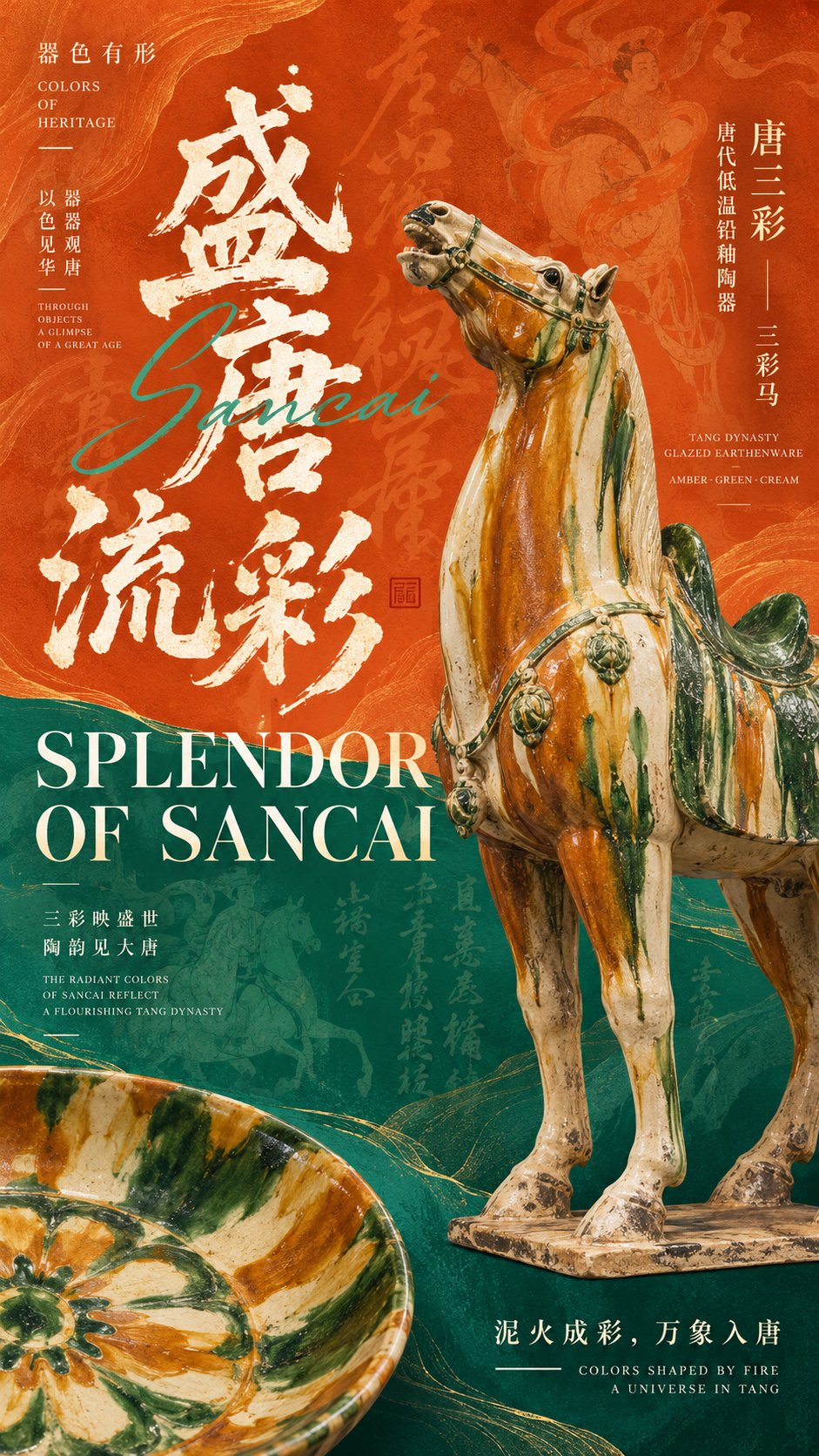
提示词
English
【Cultural Theme】: Fill in, such as Tang Sancai, blue and white porcelain, Jun kiln, Jian ware
【Core Artifact】: Fill in name, vessel shape, and material characteristics
【Chinese Main Title】: Fill in
【English Main Title】: Fill in
【Cultural Phrase】: Fill in
【Series Name】: 器色有形 / COLORS OF HERITAGE
【Main and Auxiliary Colors】: Fill in
【Visual Mode】: Dark Minerals / High-Saturation Contrasting Colors / Gradient Raster
【Aspect Ratio】: 9:16

Create a high-completion Oriental museum experimental typography art poster, integrating traditional Chinese aesthetics, museum exhibition visuals, vintage editorial design, and modern experimental Typography.

I. Artifact and Composition

Use a real artifact with authentic cultural characteristics as the core main visual, displayed in a large proportion, with accurate vessel shape, exquisite material texture, natural glaze or surface texture, and lighting layers like museum collection photography.

Allow partial enlargement of the artifact, with edges going out of frame, creating front-and-back overlapping with the text. Add a partially cropped or semi-transparent auxiliary artifact, using differences in size, virtual/real, direction, and form to establish spatial layers.

II. Typography and Layout

The Chinese main title uses huge and powerful brush calligraphy, with natural brushstrokes, flying white (feibai), and thickness variations, becoming an important visual graphic of the picture.

The English main title uses high-quality uppercase vintage serif fonts, interacting with the Chinese calligraphy and artifacts through enlargement, line breaks, dislocation, and overlapping. A small amount of elegant English cursive can be added as an auxiliary.

The layout must have a complete editorial information hierarchy, including series name, artifact name, cultural category, craftsmanship description, Chinese and English phrases, and a small amount of exquisite annotation lines. Information density is medium-high, but maintains a clear primary-secondary relationship.

III. Color and Background

Design according to the selected visual mode:

- Dark Minerals: Ink black, deep blue, copper gold, etc., integrating mineral textures, local metallic color details, semi-transparent calligraphy backgrounds, presenting a deep and heavy cultural temperament.
- High-Saturation Contrast: Use two distinct main colors for large-area partitioning, paired with organic curves, artifacts dislocated out of frame, huge fonts, and low-contrast cultural patterns, forming a vintage editorial design sense.
- Gradient Raster: Use gradient color fields such as cyan-blue and indigo-purple with spatial depth, superimposed with continuous and dense vertical rasters. Lines bend slightly at the edges of artifacts, with variations in density and front-back overlapping, forming a modern optical art effect where artifacts appear indistinctly.

The background integrates traditional calligraphy, decorative patterns, glaze flow, or historical cultural textures related to the theme, with low transparency, enriching the picture without interfering with the main information.

IV. Visual Hierarchy and Completion

Build three main visual anchors with huge Chinese calligraphy, core artifacts, and large English titles.

Form rich spatial layers and reading rhythms through partial out-of-frame artifacts, text overlapping, color contrast, background shadows, and fine lines.

From a distance, it has strong visual impact and a clear large shape; from close up, one can discover exquisite materials, calligraphy textures, cultural information, and graphic details.

The entire poster should have the completion of professional museum exhibitions, art publishing, and cultural brand design, becoming a complete work with independent thematic expression, rather than a common artifact display template.

Ensure accurate artifact modeling, clear text, precise layout, and mature colors. Avoid garbled characters, fictional exhibition news, meaningless English, cheap 3D, excessive tech special effects, random numbering, four-pointed stars, and watermarks.

Final output is a 9:16 vertical high-definition art poster.
中文
【文化主题】:填写,如唐三彩、青花瓷、钧窑、建盏
【核心器物】:填写名称、器型及材质特征
【中文主标题】:填写
【英文主标题】:填写
【文化短句】:填写
【系列名称】:器色有形 / COLORS OF HERITAGE
【主色与辅助色】:填写
【视觉模式】:深色矿物 / 高饱和撞色 / 渐变光栅
【画幅比例】:9:16

创作一张高完成度的东方文博实验字体艺术海报,融合中国传统美学、博物馆展览视觉、复古编辑设计与现代实验 Typography。

一、器物与构图

以一件具有真实文化特征的器物作为核心主视觉,大比例展示,具备准确的器型、精致的材质纹理、自然釉面或表面质感,以及博物馆藏品摄影般的光影层次。

允许器物局部放大、边缘出框,与文字产生前后遮挡。加入一件局部裁切或半透明的辅助器物,利用大小、虚实、方向与形态差异建立空间层次。

二、字体与排版

中文主标题使用巨大而富有力量的毛笔书法,具有自然的笔锋、飞白与粗细变化,成为画面的重要视觉图形。

英文主标题采用高品质大写复古衬线字体,通过放大、分行、错位与叠压,与中文书法及器物产生互动。可加入少量优雅的英文连笔字作为辅助。

画面必须具有完整的编辑式信息层级,包括系列名称、器物名称、文化分类、工艺说明、中英文短句及少量精致标注线。信息密度中高,但保持明确的主次关系。

三、色彩与背景

根据选择的视觉模式设计:

- 深色矿物: 墨黑、深蓝、铜金等色彩,融合矿物纹理、局部金属色细节、半透明书法底纹,呈现深邃厚重的文化气质。
- 高饱和撞色: 使用两种鲜明的主色进行大面积分区,搭配有机曲线、器物错位出框、巨大字体与低对比文化纹样,形成复古编辑设计感。
- 渐变光栅: 使用具有空间深度的青蓝、靛紫等渐变色场,叠加连续细密的纵向光栅。线条在器物边缘产生轻微弯曲、疏密变化和前后遮挡,形成器物若隐若现的现代光学艺术效果。

背景融入与主题相关的传统书法、装饰纹样、釉色流动或历史文化肌理,透明度较低,丰富画面但不干扰主要信息。

四、视觉层级与完成度

以巨大中文书法、核心器物和英文大标题构建三个主要视觉锚点。

通过器物局部出框、文字叠压、色彩对比、背景虚影和精细线条,形成丰富的空间层次与阅读节奏。

远看具有强烈的视觉冲击和清晰的大形,近看能发现精致的材质、书法肌理、文化信息与图形细节。

整张海报应具有专业文博展览、艺术出版和文化品牌设计的完成度,成为一件具有独立主题表达的完整作品,而不是普通的器物展示模板。

确保器物造型准确、文字清晰、排版精密、色彩成熟。避免乱码、虚构展讯、无意义英文、廉价3D、过度科技特效、随机编号、四角星芒及水印。

最终输出一张9:16竖版高清艺术海报。