东方当代文化系列海报设计提示词
来源: @MrLarus模型: ChatGPT
📸 示例图片
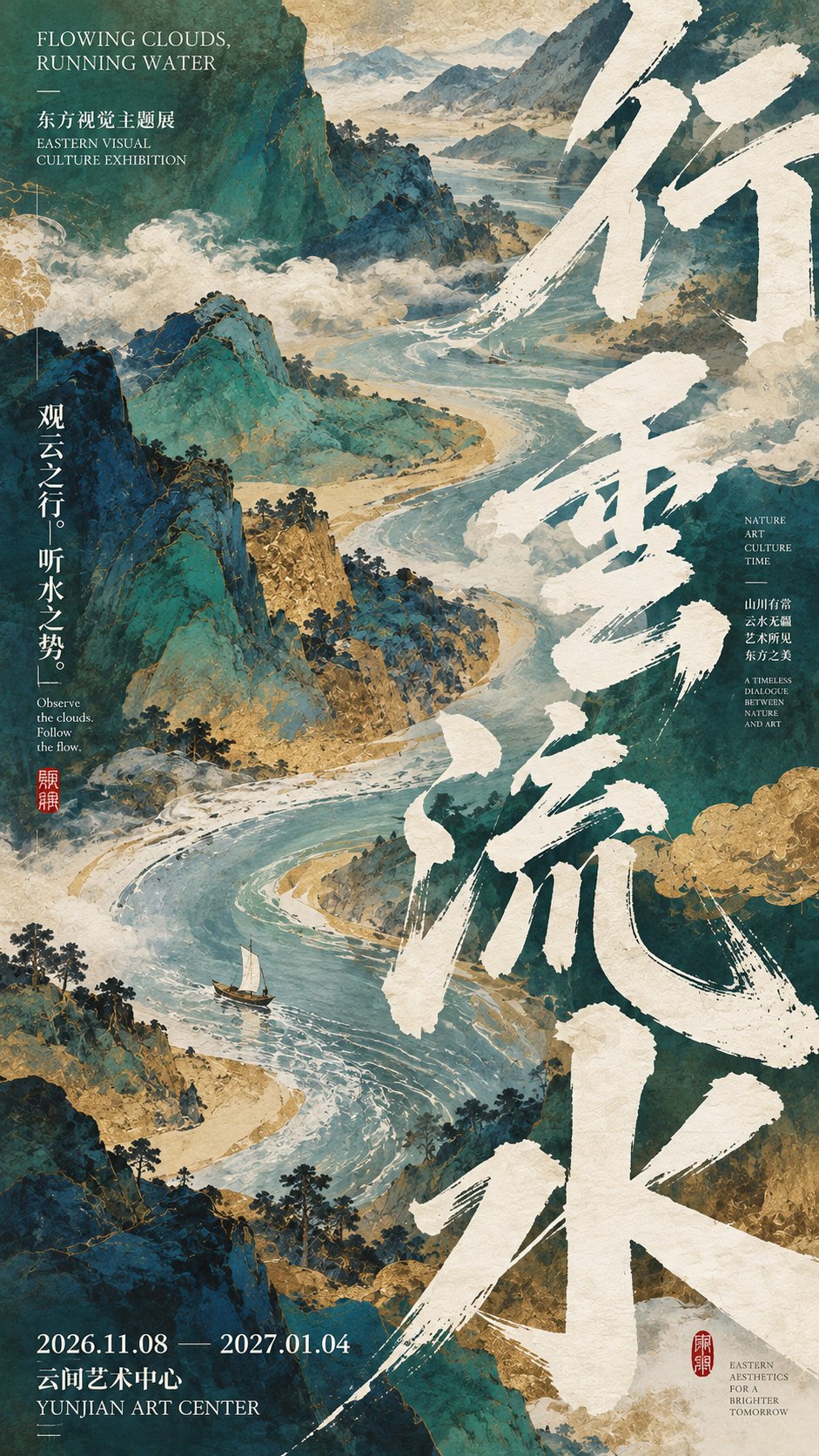
提示词
English
[Theme]: {Fill in a four-character idiom or phrase, e.g.: Floating Clouds and Flowing Water / Bright Mountains and Beautiful Waters / Clear Breeze and Bright Moon}
[English Theme]: {Fill in the corresponding English title}
[Exhibition Name]: {Can be filled in, e.g.: Oriental Visual Theme Exhibition}
[Date]: {Can be filled in}
[Venue]: {Can be filled in}
[Aspect Ratio]: 9:16

Please design a set of 4 complete Eastern contemporary culture posters around the same [Theme]. The theme, core text, and basic exhibition information of the four posters must remain consistent, but they must respectively adopt 4 sets of clearly different graphic design languages. The focus is not simply on changing the color scheme, but on changing the composition, font scale, image organization, information structure, material, and visual rhythm, allowing people to see at a glance that these are "four design solutions for the same theme."

The overall reference should be mature Eastern culture exhibitions, art museum visuals, editorial design, and contemporary graphic poster aesthetics, combining traditional Eastern elements with modern design language. Each poster must be a complete work that can stand alone, with clear thematic expression, main visual, auxiliary images, text hierarchy, and information system; do not make them template diagrams with only titles and backgrounds.

The first type is [Ink Deconstruction Style]: Use warm white Xuan paper, large areas of negative space, giant free calligraphy, ancient painting fragments, water ripples, mountain shapes, clouds, and ink marks for asymmetrical collage. Giant Chinese calligraphy directly serves as the compositional skeleton, forming occlusion, cropping, and interleaving with ancient paintings, water ripples, and ink marks, while adding a small amount of modern Chinese and English editorial information and cinnabar seals. The overall color palette is mainly black, white, and gray, with visual freedom and tension, possessing a sense of Eastern experimental art and modern editorial design.

The second type is [Modern Exhibition Style]: Adopt strict modern editorial grids, over-scaled Chinese characters, horizontal image sample strips, and a sophisticated small information system. Reorganize Eastern natural materials, ancient painting details, patterns, artifacts, or photographic images like museum research archives. Colors can use restrained combinations such as off-white, dark green, celadon gray-green, and cream yellow, letting the giant text first become a geometric composition and then be read as the theme. The overall style should have the professional visual sense of cultural institutions, art museums, and design exhibitions.

The third type is [Mineral Color Giant Word Style]: Use Eastern mineral colors such as stone blue, malachite green, ochre gold, gray blue, and beige to form a nearly full-bleed landscape color field. Form continuous visual momentum through elements like rivers, clouds, and mountains, then overlay over-scaled ivory white calligraphy. The text must truly engage in occlusion, interleaving, and front-to-back spatial relationships with the landscape, rather than simply being pasted on the background. Seen from afar, one first sees a strong color field and giant text; seen up close, one then discovers natural landscapes and details.

The fourth type is [Black Background Deconstruction Style]: Use a deep charcoal black background, giant ivory white modern Chinese fonts, Eastern artifacts, rocks, flowing cloud patterns, ancient painting silhouettes, and continuous curves for collage, then add a restrained geometric frame, thin lines, exhibit annotations, and a museum-archive-style information system. The overall palette is mainly black, ivory white, celadon gray-green, old gold, and very little cinnabar, making traditional cultural materials present the visual temperament of contemporary art exhibitions, design biennials, and high-end cultural institutions.

The four posters must maintain a clear series sense: the theme is completely consistent, the core Chinese and English titles are consistent, the basic exhibition information is consistent, and a small number of Eastern cultural identification elements are uniformly retained. However, the four must form significant differences in composition, visual focus, font expression, color system, image materials, and information organization, and cannot just be the same template with changed colors or backgrounds.

Each poster establishes a clear three-level visual hierarchy: the first level is a sufficiently strong large main visual or giant theme text; the second level is Eastern cultural images, landscapes, artifacts, ancient paintings, or other thematic visual materials; the third level is Chinese and English exhibition information, date, venue, explanatory text, and a small number of seals. Seen from afar, there must be a clear large shape and visual focus; seen up close, one then discovers rich text-image relationships and design details.

Please ensure the works have sufficient information density, layout design sense, and completeness. Do not cut corners, do not only generate "background image + centered title"; real processing of the interleaving, occlusion, cropping, proportion, negative space, hierarchy, and reading path between text and image is required, making each one look like a cultural poster fully designed by a professional graphic designer.

Avoid cheap Guochao, ancient style game UIs, travel promotion posters, ordinary landscape paintings with direct text addition, four images only with color changes, excessive symmetry, full-screen small elements, random decorations, meaningless English, gibberish text, numbering, and four-pointed stars.
中文
【主题】:{填写一个四字成语或四字词,如:行云流水 / 山明水秀 / 清风明月}
【英文主题】:{填写对应英文标题}
【展览名称】:{可填写,如:东方视觉主题展}
【日期】:{可填写}
【场馆】:{可填写}
【画幅比例】:9:16

请围绕同一个【主题】,设计一组 4 张完整的东方当代文化海报。四张海报的主题、核心文字和基础展览信息保持一致,但必须分别采用 4 套明显不同的平面设计语言。重点不是简单更换配色,而是改变构图、字体尺度、图像组织方式、信息结构、材质和视觉节奏,让人一眼看出这是“同一个主题的四种设计解法”。

整体参考成熟东方文化展览、美术馆视觉、编辑设计与当代平面海报的审美,将传统东方元素与现代设计语言结合。每张海报都必须是一件能够独立成立的完整作品,拥有明确的主题表达、主视觉、辅助图像、文字层级和信息系统,不要做成只有标题和背景的模板示意图。

第一种为【水墨解构风】:使用暖白宣纸、大面积留白、巨幅自由书法、古画碎片、水纹、山形、云气与墨迹进行非对称拼贴。巨大中文书法直接作为构图骨架,与古画、水纹和墨迹形成遮挡、裁切与穿插,同时加入少量现代中英文编辑信息和朱砂印章。整体以黑白灰为主,视觉自由、有张力,具有东方实验艺术和现代编辑设计感。

第二种为【现代展陈风】:采用严格的现代编辑网格、超尺度汉字、横向图像样本带和精细的小型信息系统。将东方自然素材、古画局部、纹样、器物或摄影图像像博物馆研究档案一样重新组织。色彩可使用米白、墨绿、青瓷灰绿、奶油黄等克制组合,让巨大文字首先成为几何构成,再被阅读成主题。整体应具有文化机构、美术馆和设计展览的专业视觉感。

第三种为【彩墨巨字风】:使用石青、青绿、赭金、灰蓝、米色等东方矿物色构成接近满版的山水色场,通过河流、云气、山体等元素形成连续视觉动势,再叠加超尺度象牙白书法。文字必须与山水真正发生遮挡、穿插和前后空间关系,而不是简单贴在背景上。远看首先看到强烈色域和巨大文字,近看再发现自然景观与细节。

第四种为【黑底解构风】:使用深炭黑背景、巨大象牙白现代中文字体、东方器物、山石、流云纹、古画剪影和连续曲线进行拼贴,再加入克制的几何框架、细线、展品注释和博物馆档案式信息系统。整体以黑、象牙白、青瓷灰绿、旧金和极少朱砂为主,让传统文化素材呈现出当代艺术展、设计双年展和高级文化机构的视觉气质。

四张海报必须保持明确系列感:主题完全一致,中文与英文核心标题一致,基础展览信息一致,并统一保留少量东方文化识别元素。但四张在构图方式、视觉重心、字体表现、色彩体系、图像材料和信息组织方式上必须形成明显差异,不能只是同一模板换颜色或更换背景。

每张海报都建立清楚的三级视觉层级:第一层是足够强烈的大型主视觉或巨大主题文字;第二层是东方文化图像、山水、器物、古画或其他主题视觉素材;第三层是中英文展览信息、日期、场馆、说明文字和少量印章。远看要有清楚的大形和视觉焦点,近看再发现丰富的图文关系和设计细节。

请保证作品具有足够的信息密度、版式设计感和完整度。不要偷工减料,不要只生成“背景图 + 居中标题”;需要真实处理文字与图像之间的穿插、遮挡、裁切、比例、留白、层级和阅读路径,使每张都像经过专业平面设计师完整设计的文化海报。

避免廉价国潮、古风游戏 UI、旅游宣传海报、普通山水画直接加字、四张仅更换颜色、过度对称、满屏小元素、随机装饰、无意义英文、乱码文字、编号和四角星芒。