现代东方纸纤维文化海报设计提示词
来源: @MrLarus模型: ChatGPT
📸 示例图片
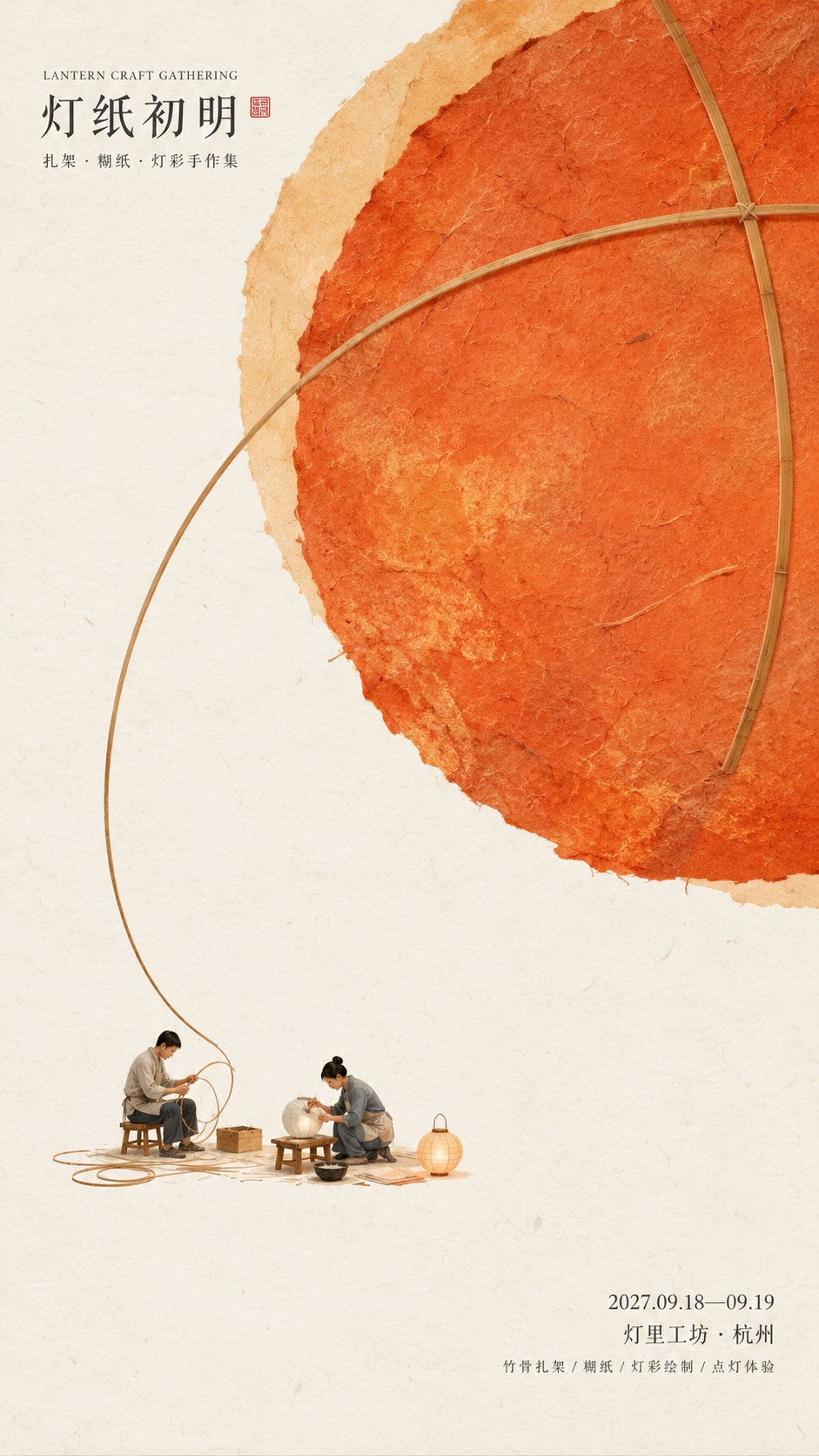
提示词
English
[Theme / Activity Name] {Fill in, e.g.: Lantern Handcrafting / Fan Making Gathering / Incense Culture / Woodblock Printing}
[Main Title] {Fill in}
[Core Main Shape] {Fill in one strongest single large shape, e.g.: Huge Paper Circle / Fan-shaped Unfold / Agarwood Color Block / Ink Black Layout}
[Main Color Gamut] {Fill in 2–4 colors, e.g.: Warm Orange + Apricot Yellow + Warm White / Celadon Green + Warm White + Cinnabar Dot Color / Agarwood Brown + Rice White / Ink Black + Warm White + Vermilion}
[Micro Scene] {Fill in a real small cultural scene, e.g.: Pasting Paper Lanterns / Fan Mounting and Pasting / Sealing Incense and Blending Incense / Woodblock Carving and Printing}
[Cultural Elements] {Fill in a few necessary artifacts, e.g.: Bamboo Ribs, Thin Paper, Incense Burner, Printing Plate, Carving Knife, Fan Ribs, Paper Lanterns, etc.}
[Activity Information] {Date / Location / Type, optional}
[Aspect Ratio] 9:16 Vertical

Design a cultural event poster with modern Oriental editorial aesthetics, using "paper fiber + large color gamut + micro scene" as the core visual language, and emphasizing a refined, quiet, and restrained handmade paper texture. The image first establishes a strongest single main shape, with the [Core Main Shape] serving as the primary visual, such as a huge circle, fan shape, low horizontal platform, or heavy black layout, so that the audience is first attracted by a clear large shape from a distance, rather than seeing many fragmented elements first.

Use [Main Color Gamut] to establish 2–4 large paper-based color blocks with significantly different areas. Create front-back, overlapping, or slight structural relationships between the color blocks, but do not stack them too full. All color blocks must have the texture of real handmade paper, watercolor pulp, or mineral pigments, with visible natural long and short fibers, pulp particles, natural variations in shade, slight indentations, and irregular torn paper edges. Maintain an overall matte, clean, and complete look, without dirt, yellow spots, strong grain, or cheap vintage filters. Colors are low-saturation but with full concentration, having clear recognizability from a distance and material details up close.

Add a very small-scale but content-complete [Micro Scene] between the large color gamuts. The characters and props overall occupy about 3%–5% of the frame. Characters must be doing a real thing, such as tying lanterns, pasting paper, making fans, covering paper, blending incense, lighting incense, carving woodblocks, inking, pressing, etc., rather than posing. Tell a quiet and clear small story through actions, tools, and spatial relationships. Only keep a few truly necessary items in the [Cultural Elements] to serve the narrative, without commercial displays or piling up traditional cultural decorations.

A very small amount of finishing touch colors can be added, such as cinnabar red, warm yellow lamplight, or small marks, but the area is usually controlled at 1%–3% and must have a real relationship with the content, such as seals, marks, lamplight, finished small works, etc., rather than random decoration. The overall visual should be "the large shape is strong from a distance, and only upon closer inspection are characters, objects, and paper fiber details discovered," possessing both aesthetic completeness and a sense of micro-narrative.

The typography adopts modern Oriental cultural institution, exhibition event, or editorial design language. The main title [Main Title] uses refined Chinese Songti, Mingti, or modern fonts with a sense of publication. The font size remains medium to small, not allowing the text to overwhelm the large color gamut. Auxiliary English, dates, locations, and explanatory information use smaller font sizes to form a clear hierarchy and maintain appropriate white space. All text must have real meaning; do not use meaningless placeholders like RANDOM, DESIGN, ART, STUDIO, etc.

The overall style should reflect the combination of paper collage, watercolor texture, micro-handcrafted scenes, and Oriental editorial layout, with a refined, calm, restrained, and breathable temperament. Avoid book cover visual clichés, traditional ancient-style illustrations, huge titles, full-screen ancient buildings, piling up of elements, PPT-style layout, commercial advertising feel, dirty old paper, 3D CGI, glass materials, plastic feel, neon colors, Logos, watermarks, numbering, and starburst decorations.
中文
【主题 / 活动名称】{填写,例如:灯彩手作 / 制扇雅集 / 香事文化 / 木刻版画}
【主标题】{填写}
【核心主形】{填写一个最强的单一大形,例如:巨大纸圆 / 扇形展开 / 沉香色块 / 墨黑版面}
【主色域】{填写 2–4 个颜色,例如:暖橙 + 杏黄 + 暖白 / 青瓷绿 + 暖白 + 朱砂点色 / 沉香褐 + 米白 / 墨黑 + 暖白 + 朱红}
【微场景】{填写一个真实的小型文化场景,例如:糊纸灯彩 / 制扇裱贴 / 篆香合香 / 刻版印刷}
【文化元素】{填写少量必要器物,例如:竹骨、薄纸、香炉、印版、刻刀、扇骨、纸灯等}
【活动信息】{日期 / 地点 / 类型,可选}
【画幅比例】9:16 竖版

设计一张具有现代东方编辑美学的文化活动海报,以「纸纤维 + 大色域 + 微场景」作为核心视觉语言,并强调精致、安静、克制的手工纸质感。画面先确立一个最强的单一主形,由【核心主形】承担第一视觉,例如巨大圆形、扇形、低矮横向平台或厚重黑色版面,让观众远看先被一个清楚的大形吸引,而不是先看到很多细碎元素。

使用【主色域】建立 2–4 个面积明显不同的大型纸本色块,色块之间形成前后关系、遮挡关系或轻微结构关系,但不要堆得太满。所有色块必须具有真实手工纸、水彩纸浆或矿物颜料质感,可见天然长短纤维、纸浆颗粒、自然浓淡变化、轻微压痕和不规则撕纸边缘,整体保持哑光、干净、完整,不做脏旧、黄斑、强颗粒或廉价复古滤镜。色彩低饱和但浓度完整,远看要有明显识别度,近看要有材料细节。

在大色域之间加入一个尺度很小但内容完整的【微场景】。人物与道具整体约占画面 3%–5%,人物必须正在做一件真实的事,例如扎灯、糊纸、制扇、覆纸、调香、点香、雕版、上墨、压印等,而不是站着摆拍。通过动作、器具和空间关系讲清楚一个安静而明确的小故事。场景中的【文化元素】只保留真正必要的几样,让器物服务于叙事,不做商品陈列,也不要堆满传统文化装饰。

可以加入极少量点睛色,如朱砂红、暖黄灯火或小印记,但面积通常控制在 1%–3%,并且要与内容有真实关系,例如封缄、印记、灯火、完成的小作品等,而不是随意装饰。整体视觉应该是“远看大形很强,近看才发现人物、器物和纸纤维细节”,既有审美完成度,也有微型叙事感。

排版采用现代东方文化机构、展览活动或编辑设计语言。主标题【主标题】使用精致的中文宋体、明朝体或具有出版感的现代字体,字号保持中小尺度,不让文字压过大色域。辅助英文、日期、地点和说明信息使用更小字号,形成清楚层级,并保留适当留白。所有文字都要有真实意义,不使用 RANDOM、DESIGN、ART、STUDIO 等无意义占位词。

整体风格要体现纸本拼贴、水彩肌理、微型手作场景与东方编辑排版的结合,气质精致、沉静、克制、有呼吸感。避免书籍封面既视感、传统古风插画、巨大标题、满屏古建筑、元素堆砌、PPT式排版、商业广告感、脏旧纸张、3D CGI、玻璃材质、塑料感、霓虹色、Logo、水印、编号和星芒装饰。