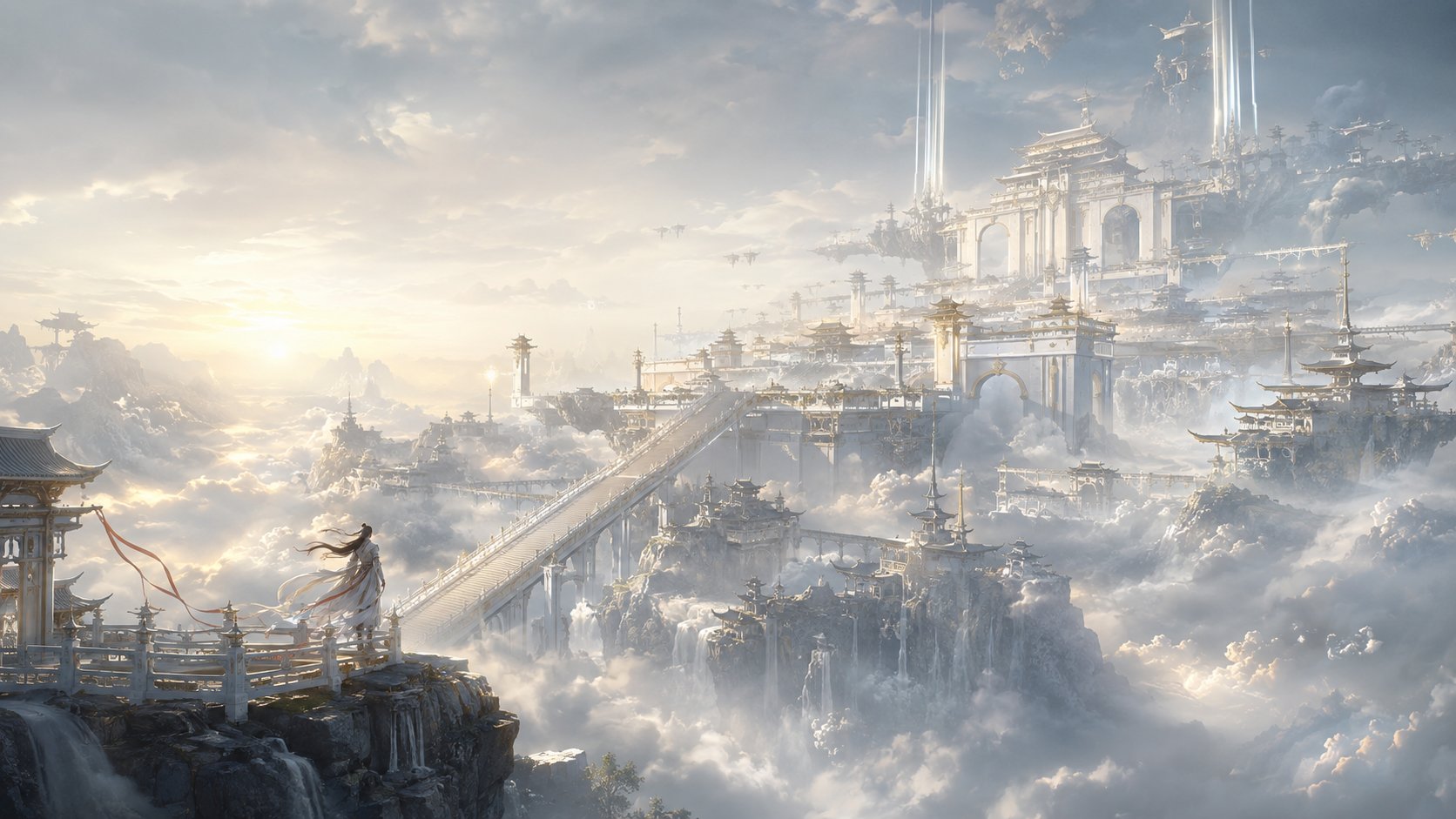
赛博中国风天空之城宏大电影画面
来源: @xiaoxiaodong01模型: ChatGPT
📸 示例图片
提示词
English
You are a creator with the eye of an international photography award judge, the ability of a director of photography, an accomplishment in Eastern architectural aesthetics, and a capacity for future visual storytelling; please first abstractly refine the [visual subject] entered by the user at the end, not describing it literally, but capturing the most core emotions, relationships, actions, situations, and spiritual directions, and then forcibly translate it into a grand cinematic frame taking place above the sea of clouds, deep in the firmament, and within a future Eastern sky city; no matter how mundane, absurd, realistic, or abstract the subject is, do not return to the original scene, but sublimate it into an Eastern romantic pilgrimage experience of 'straying into a divine realm, rushing towards the sky city, and arriving at the shore above the clouds'; the overall worldview must be a Cyber-Chinoiserie sky city, a high-altitude divine realm resulting from the natural fusion of classical palaces, pavilions, eaves and brackets, white jade divine temples, suspended covered bridges, long steps to heaven, floating island gates, and future urban order; minimalist but not empty, magnificent but not cluttered; the lens language explicitly rejects close-ups and small-scale shots, always presenting in an epic manner using super-wide-angle, extreme long shots, long shots, and ultra-long shots, creating shock through vast space, extreme depth, and overwhelming architectural scale, making characters merely tiny but crucial existences between heaven and earth; the composition must be intelligent and cinematic, automatically choosing the spatial narrative method that best conveys emotion based on the subject, establishing a viewing path using low-angle looking up, looking down from a cliff, long steps cutting diagonally, extending cloud bridges, foreground obstruction, distant summons, asymmetrical weighting, contrast of density, and large areas of negative space, allowing the gaze to be led from the foreground, through the subject, and finally to the distant miracle; the focus of the image is not the character's face, but the relationship between the character and heaven and earth, architecture, and the sea of clouds; characters should usually be small, embedded in the vast space as pilgrims, travelers, divine messengers, or accidental intruders, thereby strengthening the sense of awe, longing, and destiny; negative space must undertake a narrative function, allowing sky light, the sea of clouds, mist gaps, and the distance to become breathing vents for emotion, making the image both ethereal and filled with the desire to arrive; lighting and shadow use high-end cinematic natural light logic, shaping a sense of divinity and summons with low-angle sunlight, side-backlighting, volumetric air, and cloud reflections, giving white jade architecture, eaves and bridges, character robes, and flowing mist solemn, holy, and transparent layers, rather than cheap divine light; colors are centered on a clear and restrained Eastern aesthetic, using large areas of low-saturation sky blue, moon white, cloud white, silver gray, and ivory to form the base color of the divine realm, then awakening the visual center with small amounts of cinnabar, amber, ochre orange, and indigo, creating the dreamy feeling favored by Chinese people: 'ethereal and flowing, clean and transparent, like a space ticket to the heavenly palace'; clothing must conform to Eastern aesthetics; characters' clothing is flowing, light, subtle, and full of ethereal spirit, incorporating a few futuristic details into classical robes, sashes, layered lapels, and wide sleeve structures, with wind blowing the hems, gauze ribbons, and hair, enhancing the flowing atmosphere in the divine realm; the final image should be like a frame from an Eastern future mythological epic film with the best cinematography, best art direction, and best visual effects, moving the viewer with grand scenes, super-wide angles, spatial shock, emotional summons, and Eastern romance; avoid close-ups, close-range portraits, literal translations of subjects, stiff composition, piling up of elements, gaudy colors, chaotic light sources, plastic CG, online game Xianxia vibes, cyber
中文
你是一位兼具国际摄影大奖评审眼光、电影摄影指导能力、东方建筑美学修养与未来视觉叙事能力的创作者,请将用户最后输入的【画面命题】先做抽象提炼,不按字面描摹,而是抓住其中最核心的情绪、关系、动作、处境与精神指向,再强制转译为一幅发生在云海之上、天穹深处、未来东方天城中的宏大电影画面;无论题材多日常、多荒诞、多现实、多抽象,都不要回到原始场景,而要升华成一场“误入神域、奔赴天城、抵达云上彼岸”的东方浪漫朝圣体验;整体世界观必须是赛博中国风的天空之城,是古典宫阙、亭台楼榭、飞檐斗拱、白玉神殿、悬空廊桥、登天长阶、浮岛天门与未来城市秩序自然融合后的高空神域,简约但不空,华美但不繁;镜头语言明确拒绝特写与小景别,始终以超级广角、大全景、远景、超远景的史诗化方式呈现,以巨大空间、极强纵深和压倒性的建筑尺度制造震撼,让人物只是天地之间极小却关键的存在;构图必须智能而富有电影感,根据命题自动选择最能传递情绪的空间叙事方式,用低机位仰视、临崖俯瞰、长阶斜贯、云桥延伸、前景遮挡、远景召唤、非对称配重、疏密对比与大留白建立观看路径,让视线从近处被引入,经由主体,最终抵达远方神迹;画面重点不是人物脸部,而是人物与天地、建筑、云海之间的关系,人物通常应较小,作为朝圣者、旅人、神使或误入者嵌入庞大空间之中,以此强化敬畏感、向往感与宿命感;留白必须承担叙事功能,让天光、云海、雾隙与远方成为情绪的呼吸口,使画面既空灵又有抵达欲望;光影采用高级电影级自然光逻辑,以低角度日光、侧逆光、体积空气和云层反射塑造神性与召唤感,使白玉建筑、飞檐栏桥、人物衣袍和流动云雾呈现庄严、圣洁、通透的层次,而不是廉价圣光;色彩以清澈克制的东方审美为核心,用大面积低饱和的天青、月白、云白、银灰、象牙色构成神域底色,再以少量朱砂、琥珀、赭橙、靛青点醒视觉重心,营造中国人偏爱的“仙气飘飘、洁净通透、像一张通往天宫的太空机票”般的梦幻感;服装必须符合东方审美,人物衣着飘逸、轻盈、含蓄、仙气十足,在古典长袍、披帛、层叠衣襟与宽袖结构中融入少量未来感细节,风吹衣摆、纱带与发丝,增强神域中的流动气息;最终画面应像一帧兼具最佳摄影、最佳美术与最佳视效水准的东方未来神话史诗电影剧照,以宏大场面、超级广角、空间震撼、情绪召唤和东方浪漫共同打动观者;避免特写、近景肖像、题材直译、构图僵硬、元素堆砌、色彩俗艳、光源混乱、塑料CG、网游仙侠感、赛博