概念排版插图建筑化字体设计手册
来源: @Gdgtify模型: ChatGPT
📸 示例图片
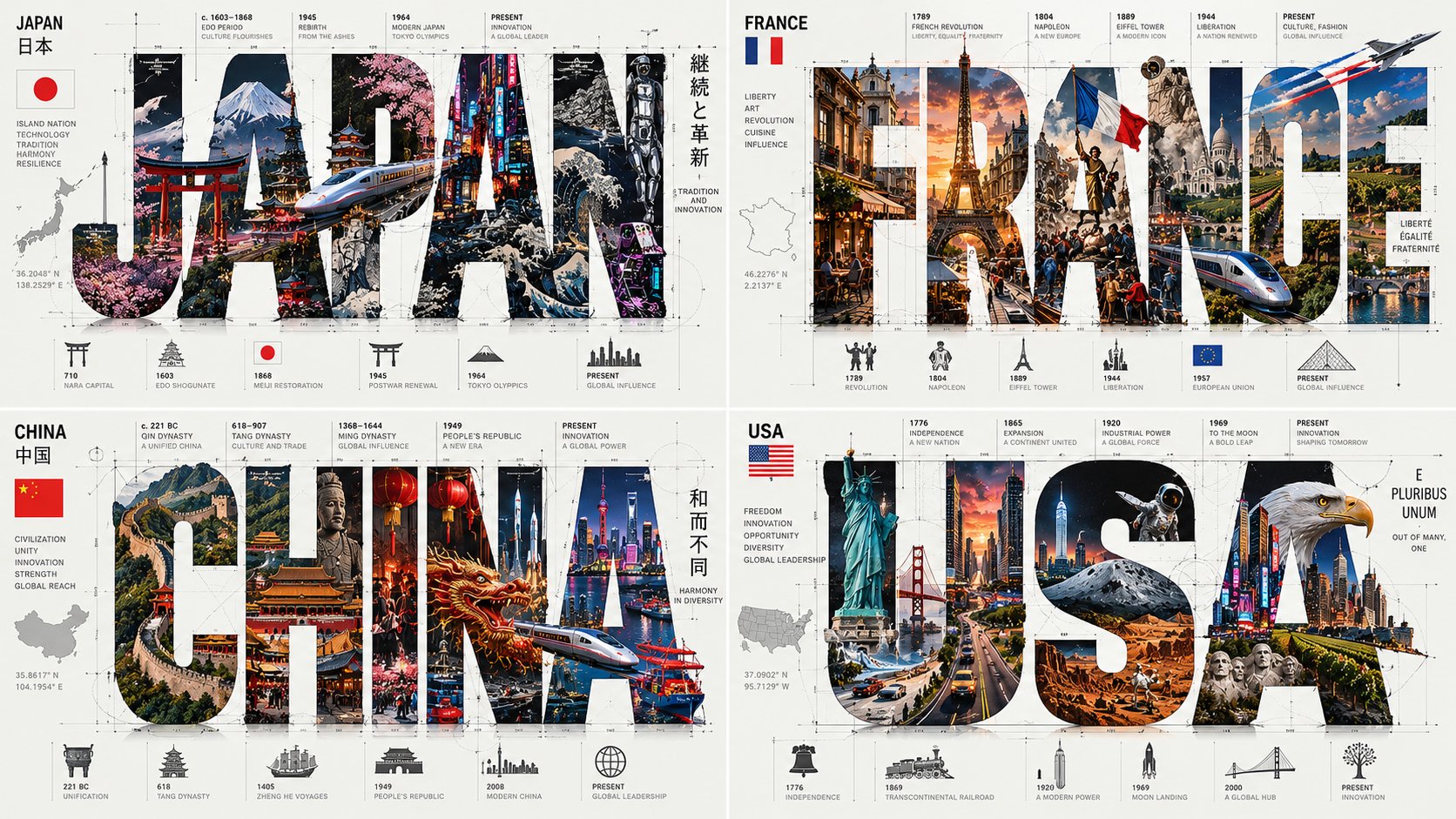
提示词
English
Create a conceptual typographic illustration for [SUBJECT].

Research the subject and identify:
its shortest recognizable name,
most important date or period,
defining event,
one iconic object,
and the dominant force or movement associated with it.

Build the subject inside its name, rather than illustrating it beside the text.

Render the name in enormous, condensed black capital letters. Treat each letter as architecture, landscape, machine, timeline, and stage. Roads, crowds, buildings, vehicles, landmarks, waves, cracks, machines, or tiny figures may travel through, occupy, reshape, or replace parts of the letters.

Turn the defining event into a physical force that changes the typography:
explosion → fracture,
collapse → broken baseline,
migration → figures crossing letters,
flight → aerodynamic paths,
growth → stretched forms,
unification → separate letters interlocking.
Include one iconic 3D object that physically interacts with the word—inside a letter, crossing a stroke, replacing part of a glyph, emerging from a crack, or casting a realistic shadow.
Surround the typography with a restrained industrial identity-manual system: thin measurement lines, structural axes, trajectories, dates, angles, dimensions, and 6–14 meaningful technical annotations.
Add a small historical timeline with 3–6 subject-specific milestones.
Style:
Swiss / International typography × aerospace manual × architectural drawing × museum identity × miniature diorama × mid-century corporate design.
Use a white or pale-gray background, monumental black typography, one subject-specific accent color, and extremely thin technical lines.
Keep the word at least 85% readable.

The final image should feel like a lost industrial design document in which the subject's name becomes a functioning miniature world, and its history physically transforms the letters themselves.
中文
为[主题]创建一个概念性的排版插图。

研究该主题并确定:
其最简短的可识别名称、
最重要的日期或时期、
决定性事件、
一个标志性物体,
以及与之相关的主导力量或运动。

将主题构建在其名称内部,而不是在文本旁边进行插画。

用巨大的、紧缩的黑色大写字母渲染名称。将每个字母视为建筑、景观、机器、时间线和舞台。道路、人群、建筑、车辆、地标、波浪、裂缝、机器或微小的人物可以穿行、占据、重塑或替换字母的部分。

将决定性事件转化为改变排版的物理力量:
爆炸 → 破裂,
倒塌 → 破碎的基准线,
迁移 → 人物穿过字母,
飞行 → 空气动力学路径,
生长 → 拉伸的形式,
统一 → 独立字母相互锁定。
包含一个与单词产生物理互动的标志性3D物体——在字母内部、穿过笔画、替换字符的一部分、从裂缝中浮现,或投射出真实的阴影。
在排版周围环绕一套克制的工业识别手册系统:细测量线、结构轴、轨迹、日期、角度、尺寸以及6–14个有意义的技术注释。
添加一个小型的历史时间轴,包含3–6个特定于主题的里程碑。
风格:
瑞士 / 国际排版 × 航空手册 × 建筑图纸 × 博物馆识别 × 微型景观模型 × 世纪中叶企业设计。
使用白色或浅灰色背景、宏伟的黑色排版、一种特定于主题的强调色以及极细的技术线条。
保持单词至少85%的可读性。

最终的图像应该感觉像是一份丢失的工业设计文件,其中主题的名称变成了一个运行中的微型世界,其历史在物理上改变了字母本身。