山海经奇兽低多边形二向色玻璃装置
来源: @DeepBlueX0模型: ChatGPT
📸 示例图片
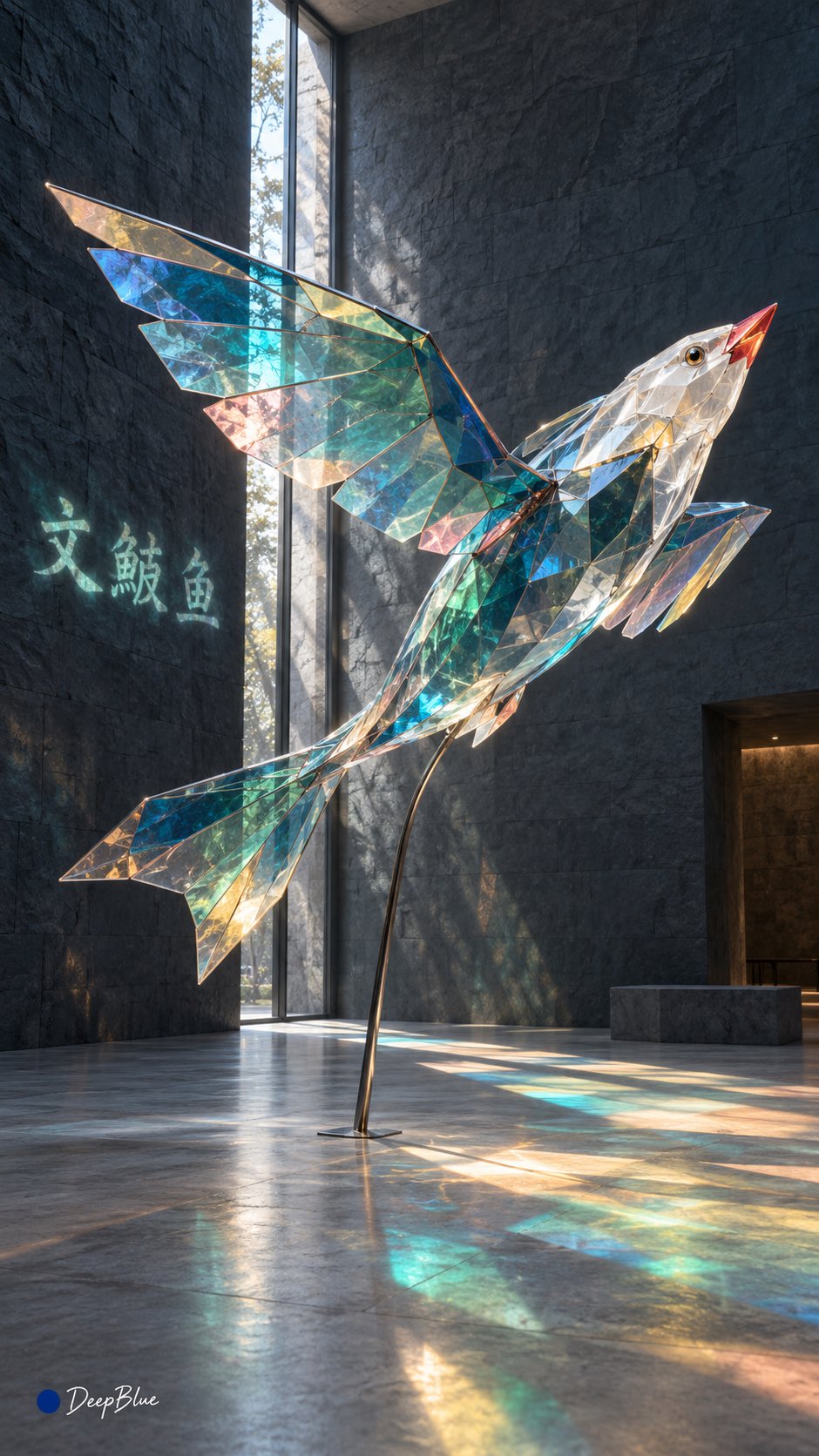
提示词
English
Classic of Mountains and Seas mythical creatures × Low poly modeling × Dichroic glass art × Colored transmission and reflection × Spatial light and shadow × Name text projection.

Each image independently selects a mythical creature from the "Classic of Mountains and Seas" with a distinct silhouette suitable for glass expression, transforming it into a concise spatial art installation. Body shapes and identity characteristics are preserved according to the original text, ensuring accurate key structures and numbers. 10 mythical creatures and main structures vary, with each re-changing posture, glass composition, camera position, composition, architectural space, and sunlight direction.

Establish coherent volumes with a small number of broad, layered polygonal glass surfaces, adding facets only at silhouettes and major structural transitions. Primarily use quadrilaterals and irregular polygons, with local triangular surfaces assisting transitions; large flat areas remain intact, and internal spaces are concise.

The torso maintains a complete block, while limbs use simple folded surfaces to express joints and force. Horns, wings, tails, etc., use broad thin surfaces or simple polyhedrons based on their own forms, naturally connecting to the body. Prioritize ensuring accurate structural identification, then arrange posture and perspective so that connection points and ends are easy to identify, with clear gaps between silhouettes.

Movements possess biological logic, with body orientation, center of gravity, and auxiliary structures echoing each other, preserving a primitive and mysterious sense of life, with highly generalized surface details.

Adjacent glass surfaces are simply joined along common edges, building volume with different angles. Surfaces are flat, thin plate thickness and hard edges are clear, joints are restrained, and supports or suspensions follow the center of gravity, making production and installation credible.

The glass is clear, the background is recognizable through the main glass surfaces, and the overlap of front and back surfaces remains clear. Organize colors according to the temperament of the mythical creatures; color rendering changes with orientation and transmission/reflection relationships. Adjacent folded surfaces have different colors, remain relatively complete within the face, with delicate changes at edges and small overlaps, preserving colorless transparent areas.

Clear sunlight forms a set of primary colored light relationships; colored transmitted and reflected light falls on the ground or walls, with broad and sparse color blocks whose positions and shapes match the glass orientation and light path, with light auxiliary reflections.

Hidden small projectors use text templates and dichroic filters to project the accurate Chinese name of the mythical creature onto blank spaces on walls or floors, appearing only once. Use clear and upright Regular Script (Kaishu); the size adjusts with the number of characters and space, readable in the complete frame, with visual weight lower than the main subject. Prefer darker walls in the side-rear; choose positions on the ground with smaller perspective tilt.

The name adopts one color from the main light, with local light color differences, restrained brightness, clear character shapes, and slightly soft edges. The texture of the receiving surface is naturally visible; the text follows planar perspective and is appropriately staggered from main colored light blocks.

Concise neutral-colored architectural environment; spatial scale, background brightness, and light change with the modeling. The subject is fully in the frame, leaving comfortable margins all around, balancing creature identification, three-dimensional structure, spatial light and shadow, and name reading. Real art installation photography, natural exposure, clear layers of glass and colored light, with the subject maintaining the visual focus.
中文
山海经奇珍异兽 × 低多边形造型 × 二向色玻璃艺术 × 彩色透射与反射 × 空间光影 × 名称文字投影

每张独立选择一种《山海经》中轮廓鲜明、适合玻璃表达的奇珍异兽,转化为简洁的空间艺术装置。依据原文保留体形与身份特征,确保关键结构及数量准确。10张异兽与主结构各异,每张重新变化姿态、玻璃构成、机位、构图、建筑空间与日光方向。

以少量宽阔、大小有层次的多边形玻璃面建立连贯体积,仅在轮廓与主要结构转折处增加分面。以四边形及不规则多边形为主,局部三角面辅助转折,大面积平缓部位保持完整,内部空间简洁。

躯干保持完整体块,肢体以简练折面表现关节与受力。角、翼、尾等依据自身形态采用宽阔薄面或简练多面体,与身体自然连接。优先保证辨识结构数量准确,再安排姿态与视角,使连接位置和末端便于辨认,轮廓间保留疏朗空隙。

动作具有生物逻辑,身体朝向、重心与附属结构相互呼应,保留古拙、神秘的生命感,表面细节高度概括。

相邻玻璃面沿共同边缘简洁衔接,以不同倾角建立体积。表面平整,薄板厚度与硬质边缘清楚,接缝克制,支撑或悬吊顺应重心,制作与安装可信。

玻璃清透,背景可透过主要玻璃面辨认,前后表面的叠合保持清楚。依据异兽气质组织色彩,显色随朝向及透射、反射关系变化。相邻折面色彩有别,面内相对完整,边缘与少量交叠处细腻变化,保留无色透明区域。

明确日光形成一组主要色光关系,彩色透射光与反射光落在地面或墙面,色块宽阔疏朗,位置与形状符合玻璃朝向和光路,辅助反光轻淡。

隐蔽的小型投影灯通过文字字模与二向色滤色片,将异兽准确中文名投在墙面或地面的留白处,仅出现一次。采用清楚端正的楷书,尺寸随字数与空间调整,完整画面中可读,视觉分量低于主体。优先选择侧后方较暗墙面;地面选择透视倾斜较小的位置。

名称沿用主要色光中的一种颜色,局部轻淡色差,亮度克制、字形清晰、边缘微柔。承接表面纹理自然可见,文字遵循平面透视,与主要彩色光块适当错开。

简洁的中性色建筑环境,空间尺度、背景明度与光线随造型变化。主体完整入镜,四周留出舒适边距,兼顾异兽辨识、立体结构、空间光影与名称阅读。真实艺术装置摄影,自然曝光,玻璃与色光层次清楚,主体保持视觉重心。