十六宫格社论人像摄影姿势与隐藏视觉
来源: @DeepBlueX0模型: ChatGPT
📸 示例图片
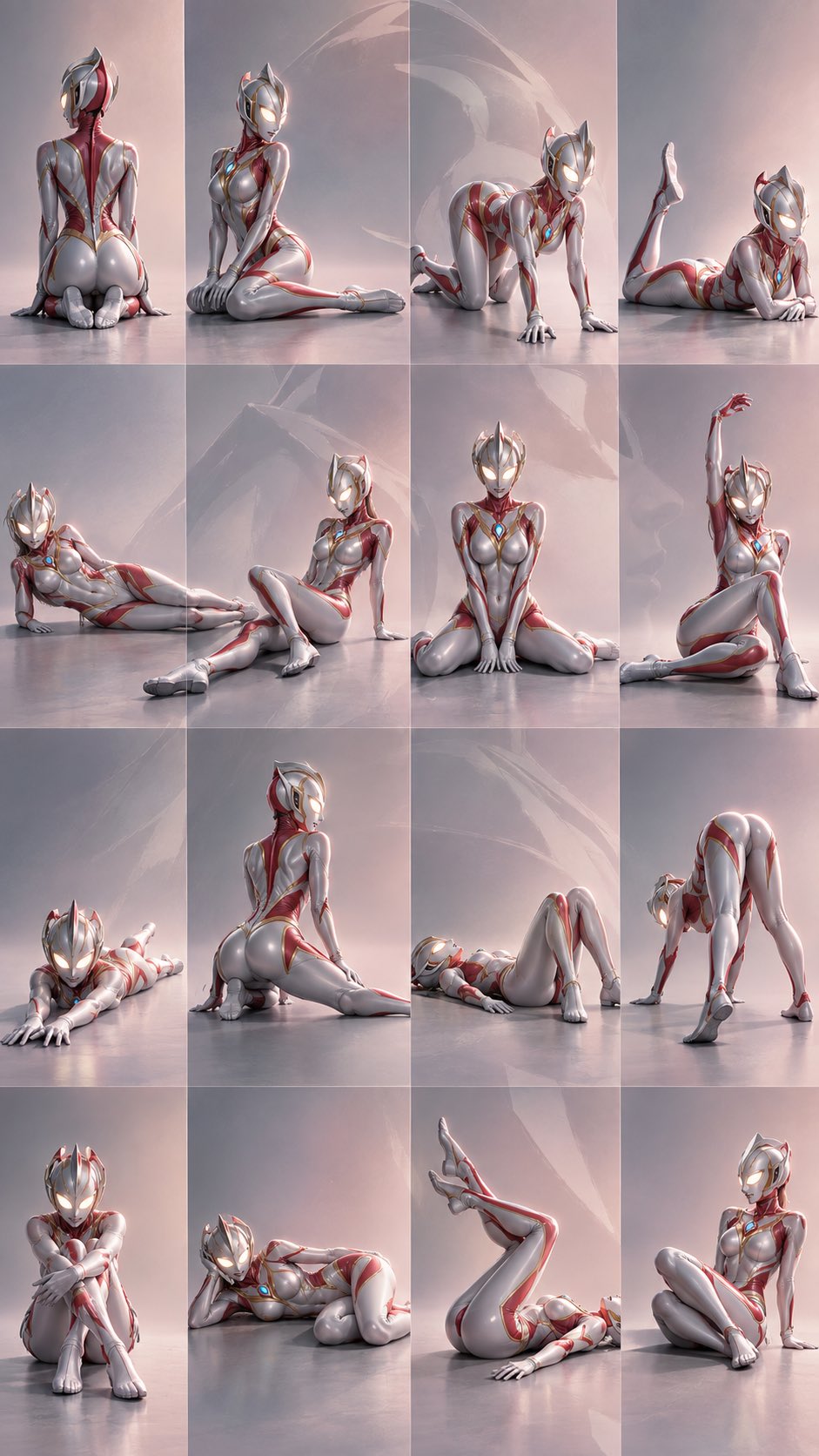
提示词
English
16-grid pose map x Editorial portrait photography x Subject: [XXX]

Generate 1 complete 9:16 vertical 4x4 figure pose map, totaling 16 independent frames.

Highest priority: The physical structure of the 16 frames must strictly correspond to 01 through 16, and differences cannot be created solely through lens angles, character orientation, expressions, or cropping; differences must come from the physical structure, with each frame using different body support, leg, or torso structures.

I. Subject Consistency
The 16 frames maintain the same subject identity, appearance, body type, hairstyle, hair color, clothing, accessories, and core visual features consistent; hair, hems, and wrinkles may change naturally with movement. The subject is always the primary visual subject. The subject's identity, clothing, and visual features must not drift due to pose changes.

II. 16 Types of Poses
01 Rear kneeling style
Both knees on the ground, hips back near the heels, body facing away from the camera, upper body upright, forming a clear rear character silhouette.

02 Side leg extension kneeling style
Both knees on the ground, one leg extended to the side of the body, the other leg remains bent, upper body upright, forming clear lateral leg lines.

03 Four-point diagonal kneeling style
Both hands and knees on the ground, forming a clear four-point support, body in a distinct diagonal structure, one leg extended to the side front.

04 Prone single leg lift style
Body completely prone, upper body supported by forearms, one leg bent and lifted backwards and upwards, the other leg remains extended.

05 Pure side-lying leg extension style
Body completely side-lying, one arm supporting the upper body, legs extended along the body direction, forming a clear pure side profile.

06 Side-sitting rear-support leg extension style
Sitting position, one leg extended forward, the other leg bent and tucked, body leaning back, one hand supporting weight on the ground behind the body.

07 Frontal open kneeling style
Both knees on the ground, body facing the camera, legs widely opened to the left and right, hands placed naturally.

08 Single arm raised sitting style
Sitting position, one leg bent and tucked, the other leg naturally extended, one hand reaching upwards, the other hand supporting or maintaining body balance.

09 Prone forward extension style
Body completely prone, legs extended backwards, both arms fully straightened in front of the body, forming a clear sense of depth.

10 Rear side-kneeling leg extension style
Body facing away or diagonally away from the camera, both knees on the ground, one leg fully extended to the side rear of the body, upper body upright.

11 Supine knee-bend style
Body completely supine, back flat on the ground, both knees bent upwards, feet close to the ground, head and shoulders remaining flat on the ground.

12 Ultra-low position rear four-point style
Both hands and feet on the ground, hips clearly raised, body forming a compact inverted V-shape structure, high-hip low-body four-point structure, observed from a rear low-angle view.

13 Sitting leg-hug style
Sitting position, both legs tucked and crossed in front of the body, both arms hugging the legs, upper body slightly contracted forward.

14 Side-lying head-support leg-bend style
Body completely side-lying, one hand supporting the head, both legs bent and tucked toward the body at the same time.

15 Supine leg-lift style
Body completely supine, both legs clearly lifted off the ground and bent upwards, forming a prominent vertical leg structure.

16 Rear-support side-sitting leg-tuck style
Sitting position, both legs completely tucked and folded to one side of the body, body clearly leaning back, one hand supporting the ground behind, the other hand placed naturally, forming a compact lateral silhouette.

The 16 poses must have clear physical structure differences, strictly executed from 01 to 16, without swapping, repeating, or omitting.

III. Grid Composition
Strict arrangement:
01 02 03 04
05 06 07 08
09 10 11 12
13 14 15 16

Each frame presents only one complete subject and the corresponding pose. Unify Editorial portrait photography language, character scale, clothing system, and background logic. The character is completely in-frame, with clear physical structures, hands, feet, knees, elbows, and support relationships. The boundaries between frames are clear, with no overlapping, bleeding between frames, swapping of poses, omissions, or repetitions.

IV. Background System
Extract primary and adjacent colors based on the subject's clothing, hair color, representative colors, and visual identity, with a maximum of two core hues, to generate a low-saturation, low-contrast minimalist gradient background.
Use only large areas of pure color and slow gradients, without adding environments, props, textures, complex lighting, or decorative elements.
The 16 frames share the same gradient logic, remaining unified, clean, and continuous, while preserving large areas of negative space. The background must not form a specific scene.

V. 16-Grid Hidden Visual
Treat the 16 backgrounds as a continuous large gradient plane.
Fixed hidden visual: A low-contrast 45-degree side profile silhouette of the subject themselves.
Generate the silhouette based on the subject's facial features, hairstyle, and core visual characteristics, integrated into the background with extremely weak light and dark changes, and continuously split into 16 fragments, naturally connected in a 4x4 grid.
The hidden silhouette uses only the current subject's features and does not introduce other characters; it remains low-contrast, low-saturation, and weakly visible, existing only in the background's negative space.
It only represents abstract continuous light and dark forms, without presenting specific features such as eyes, nose, or mouth.
In a single frame, only local light and dark forms can be seen; the complete side profile can only be recognized when viewing the 4x4 as a whole.
It must not cover the subject, interfere with the poses, add extra characters, form a second subject, or produce a watermark effect; the hidden silhouette must not become an independent face.

VI. Visual Hierarchy
First layer: The subject and the 16 poses.
Second layer: Minimalist low-saturation gradient background.
Third layer: 16-grid continuous hidden visual.
Subject clarity takes priority over background continuity, and background continuity takes priority over the hidden visual.

VII. Final Output
Generate only 1 complete 9:16 vertical image, containing a total of 16 independent character frames in a 4x4 layout.
Strictly execute 01 to 16, without omission or repetition.
Do not add titles, explanatory text, logos, magazine layout text, or other format text.
A single frame is a complete and clear Editorial portrait pose scene; the whole forms a unified 16-grid, with a 45-degree side profile silhouette of the subject composed of the 16 frames hidden in the background.
中文
16宫格姿势图×Editorial人像摄影×主体:【XXX】

生成1张完整的9:16竖版4×4人物姿势图,共16个独立画面。

最高优先级:16格身体结构严格对应01至16,不能仅通过镜头角度、人物朝向、表情或裁切制造差异;差异必须来自身体结构,每格使用不同的身体支撑、腿部或躯干结构。

一、主体一致性
16格保持同一主体的身份、外貌、体型、发型、发色、服装、配饰与核心视觉特征一致;头发、衣摆、褶皱可随动作自然变化。主体始终为第一视觉主体。主体身份、服装与视觉特征不得因姿势变化而漂移。

二、16种姿势
01后方跪坐式
双膝着地,臀部向后靠近脚跟,身体背向镜头,上身保持直立,形成明确的后方人物轮廓。

02侧展腿跪坐式
双膝着地,一条腿向身体侧方展开,另一条腿保持弯曲,上身直立,形成明显的侧向腿部线条。

03四足斜向跪姿式
双手与双膝着地,形成明确四点支撑,身体呈明显斜向结构,一侧腿向侧前方展开。

04俯卧单腿抬起式
身体完整俯卧,上身由前臂支撑,一条腿向后上方弯曲抬起,另一条腿保持伸展。

05纯侧卧伸腿式
身体完整侧卧,一侧手臂支撑上身,双腿沿身体方向伸展,形成清晰的纯侧面轮廓。

06侧坐后撑伸腿式
坐姿,一条腿向前伸展,另一条腿弯曲收拢,身体向后倾,一只手在身后撑地承担重量。

07正面展开跪坐式
双膝着地,身体正对镜头,双腿向左右两侧大幅展开,双手自然放置。

08单臂抬手坐姿式
坐姿,一条腿弯曲收拢,另一条腿自然展开,一只手向上延伸,另一只手支撑或保持身体平衡。

09俯卧前伸式
身体完整俯卧,双腿向后伸展,双臂向身体前方充分伸直,形成明显的纵深方向。

10后方侧跪伸腿式
身体背向或侧背向镜头,双膝着地,一条腿向身体侧后方充分伸展,上身保持直立。

11仰卧屈膝式
身体完整仰卧,背部贴地,双膝向上弯曲,双脚靠近地面,头部与肩部保持贴地。

12极低位后方四足式
双手与双脚着地,臀部明显抬高,身体形成紧凑的倒V形结构,呈高臀低身的四足结构,从后方低机位观察。

13坐姿环抱腿式
坐姿,双腿向身体前方收拢并交叠,双臂环抱双腿,上身略微向前收缩。

14侧卧托头屈腿式
身体完整侧卧,一只手托住头部,双腿同时弯曲并向身体方向收拢。

15仰卧抬腿式
身体完整仰卧,双腿明显抬离地面并向上弯曲,形成突出的纵向腿部结构。

16后撑侧坐收腿式
坐姿,双腿完全收拢并向身体一侧折叠,身体明显后倾,一只手在身后撑地,另一只手自然放置,形成紧凑的侧向轮廓。

16个姿势必须有明确身体结构差异,严格按01至16执行,不交换、不重复、不遗漏。

三、宫格构成
严格排列:
01 02 03 04
05 06 07 08
09 10 11 12
13 14 15 16

每格仅呈现一个完整主体和对应姿势。统一Editorial人像摄影语言、人物尺度、服装系统与背景逻辑。人物完整入镜,身体结构、手脚膝肘及支撑关系清晰。格间边界清晰,不重叠、不串格、不交换姿势、不遗漏、不重复。

四、背景系统
根据主体服装、发色、代表色与视觉身份提取主色及邻近色,最多两种核心色相,生成低饱和、低对比度极简渐变背景。
仅使用大面积纯净色彩与缓慢渐变,不添加环境、道具、纹理、复杂光影或装饰元素。
16格共享同一渐变逻辑,保持统一、干净、连续,并保留大面积负空间。背景不得形成具体场景。

五、16宫格隐藏视觉
将16个背景视为连续的大型渐变平面。
固定隐藏视觉:主体本身的低对比度45度侧脸轮廓。
根据主体脸部特征、发型与核心视觉特征生成轮廓,以极弱明暗变化融入背景,并连续拆分为16个片段,按4×4自然衔接。
隐藏轮廓仅使用当前主体特征,不引入其他人物;保持低对比、低饱和、弱可见,仅存在于背景负空间。
仅表现抽象连续的明暗形态,不呈现眼睛、鼻子、嘴巴等具体五官。
单格只能看到局部明暗形态,完整观看4×4时才能辨认完整侧脸。
不得覆盖主体、干扰姿势、添加额外人物、形成第二主体或产生水印效果;隐藏轮廓不得成为独立人脸。

六、视觉层级
第一层:主体与16种姿势。
第二层:极简低饱和渐变背景。
第三层:16格连续隐藏视觉。
主体清晰度优先于背景连续性,背景连续性优先于隐藏视觉。

七、最终输出
只生成1张9:16竖版完整图片,内部为4×4共16个独立人物画面。
严格执行01至16,不遗漏、不重复。
不添加标题、说明文字、Logo、杂志排版文字或其他版式文字。
单格为完整、清晰的Editorial人像姿势画面;整体形成统一的16宫格,并在背景中隐藏由16格共同组成的主体45度侧脸轮廓。